Description
Best fit: industrial plants with a large storage requirement, hotel and residential compounds, irrigation and livestock facilities, and buildings that must hold a fire reserve — wherever the tank can be buried and long service life matters more than fast installation.
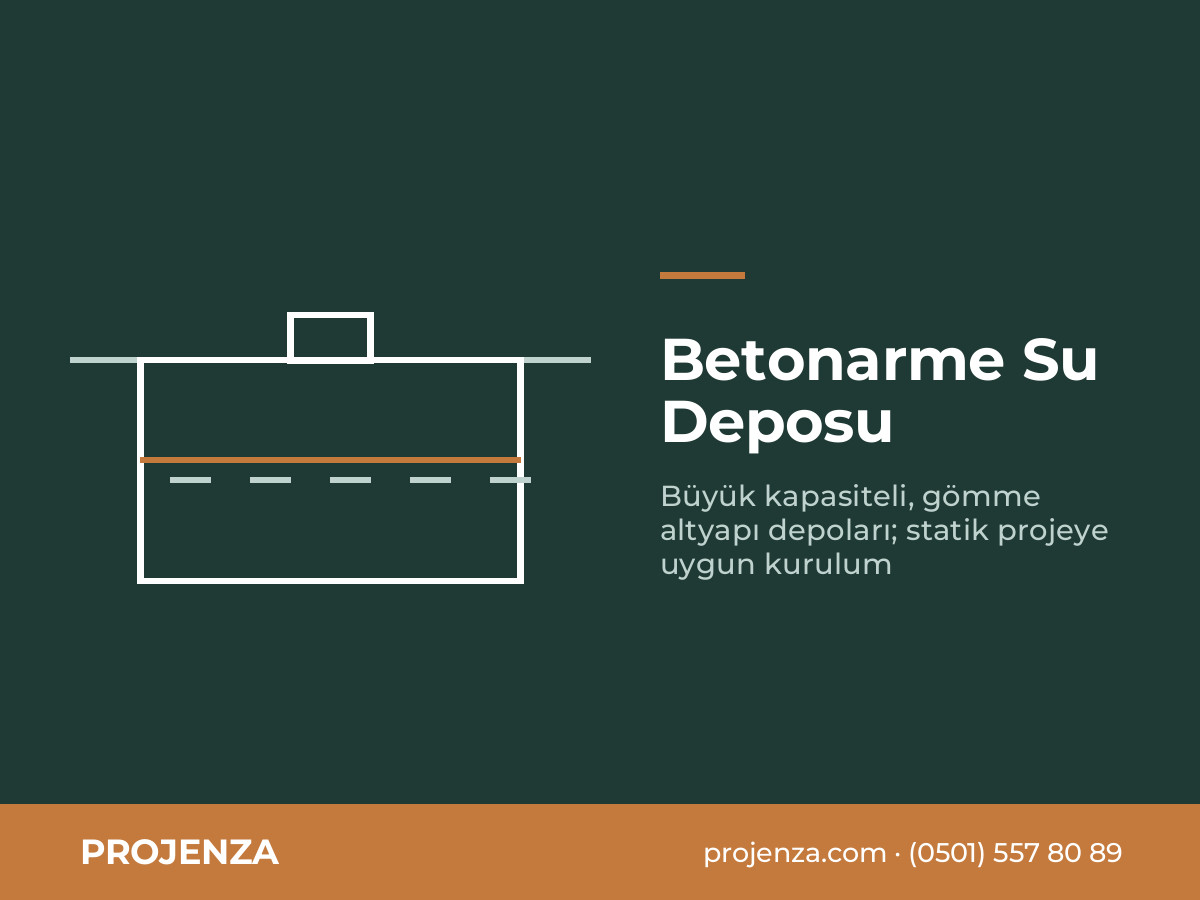
A concrete water tank is a reinforced structure cast on site or assembled from precast panels: it belongs to the building works rather than being a vessel bought off the shelf. As the required volume grows, the cost per unit of stored water turns in its favour, and the structure itself can carry earth cover, traffic load or a slab above it. That is why large reserves — process water, irrigation water, fire storage — are usually held in concrete rather than in a plastic vessel.
The engineering question is rarely the concrete itself; it lies in the joints and the penetrations. Construction joints need a waterstop and a pour sequence planned in advance, pipe penetrations need a detail that stays tight while the structure moves, and reinforcement is arranged to limit crack width rather than to forbid cracking altogether. A leak is never only lost water: moisture travels along the crack to the reinforcement and starts corrosion that costs far more than the water ever did.
Burying the tank changes the load case. With a high water table an empty tank wants to float, and uplift is resisted by self weight, by earth cover, by a widened base or by drainage that keeps the water level down — and the governing condition in that check is the empty tank, not the full one. Bearing capacity and differential settlement are checked for the full tank, while in seismic design the water sloshing inside becomes a load in its own right.
Where drinking water is stored the inner surface has to stay inert: the lining must not give the water taste or odour and must withstand contact with chlorine. A concrete shell lets no light through, which suppresses algae, and once buried the water temperature swings far less over the year than it does in an above ground vessel. The openings decide the rest: a screened vent, an overflow that cannot draw anything back in, and a sealed, lockable manhole raised above the surrounding ground level.
Operation is designed at the same time as the structure. A tank split into two compartments can be cleaned one side at a time without cutting supply, which is the difference between a planned wash down and a shutdown. The suction level decides how much of the stored volume is genuinely usable, and where a fire reserve sits in the same tank, a separate suction level stops daily use from eating into it. After that it is routine: periodic emptying and cleaning, inspection of the lining, and a record of crack and joint condition over time.
Key Features
- Cast in place reinforced structure or precast panel assembly, with a favourable cost per unit volume at large capacities
- Waterstops at construction joints and sealed details where pipes pass through the wall
- Reinforcement arranged to limit crack width, with cover maintained throughout the pour
- Inner lining suitable for drinking water, leaving neither taste nor odour
- Opaque shell that suppresses algae growth, with stable water temperature once buried
- Screened ventilation, an overflow protected against backflow, and a sealed lockable manhole
- Compartmented layout that allows one side to be cleaned while supply continues
How to Choose
- Volume and usage profile: the daily draw, how often the stored water turns over, and whether a fire reserve is to be held separately.
- Ground and water table: bearing capacity, groundwater level, and how uplift on the empty tank is to be resisted.
- Type of water stored: drinking, process, irrigation or fire water — the lining and the cleaning regime follow from this.
- Placement: fully buried, partly buried or above ground, together with access, manhole position and the maintenance route.
- Construction method: monolithic cast in place or precast panels, judged against site access and programme constraints.
- Operation and maintenance: the need for compartmented running, cleaning frequency, lining inspection and record keeping.
Get a free site survey and a quote for your project: (0501) 557 80 89 · bilgi@projenza.com
Reviews
There are no reviews yet.