
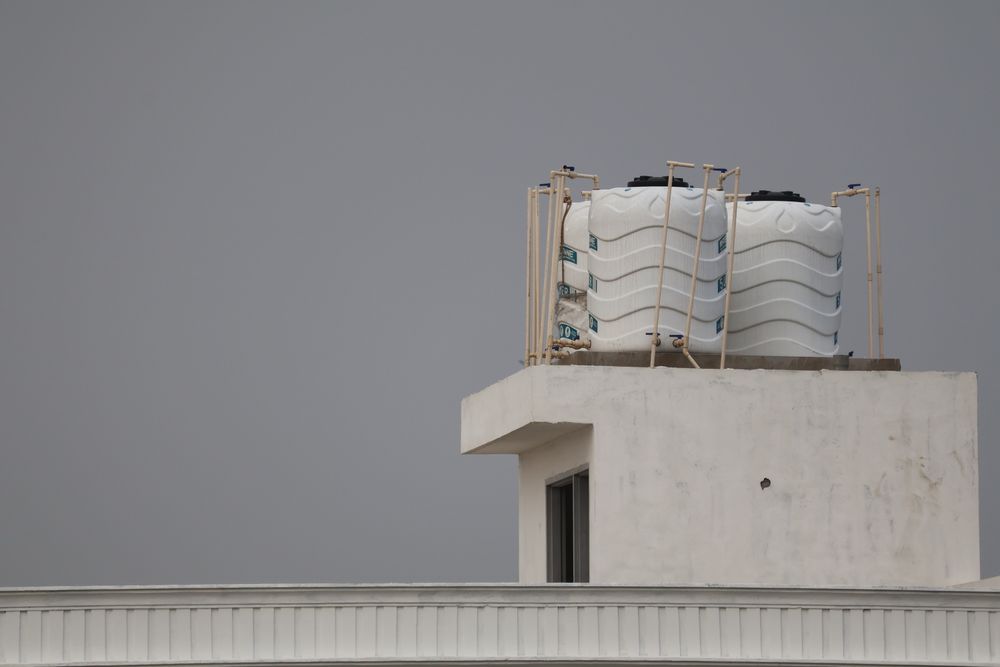
Description
Where it is the right choice: homes, villas and small businesses in the 1-5 tonne range. Being light, it raises no structural load problem on a roof or terrace.
A polyethylene tank is the most widespread solution at domestic scale: economical, light, and thanks to its one-piece body it needs no additional sealing work. It is used both as backup against supply cuts and as the suction reservoir for a booster set.
Look at two things when choosing. First, the suitable for contact with food marking — for potable and domestic water this is not negotiable. Second, a dark body that does not let light through: a tank that admits light is an open invitation to algae. On volume, “let’s go big” is the wrong instinct; in an oversized tank the water waits for days and goes stale. In a home the practical rule is to back up one to two days of demand at 150-200 litres per person per day.
A tank on its own is not the solution: storing the water is the tank’s job, getting it up to the top floors under pressure is the booster set’s. Designing the two together removes overflow, dry running and pressure problems from the outset.
Key Features
- Food-grade polyethylene material
- Dark, light-proof body — prevents algae growth
- One-piece body: no additional welding or sealing work
- Light; a structural load advantage on roofs and terraces
- Vertical and horizontal models to suit the available space
How to Choose
- Volume: calculated from the number of people and the pattern of supply cuts; 1-1.5 tonnes suits a family of four in most scenarios.
- Lid and vent: the lid must seal and the vent must be insect-screened — insects and dust are the most common source of contamination.
- Inlet and outlet position: placed so that the water turns over; in a tank with a dead corner the water stagnates there.
- Cleaning: drain, wash and disinfect at least once a year.
Get a free site survey and a quote for your project: (0501) 557 80 89 · bilgi@projenza.com
Reviews
There are no reviews yet.