
Description
Where it is the right choice: as the number of spaces grows, multi-split strains in both pipework and management; at office floor, hotel, tower and mall scale VRF has no alternative left.
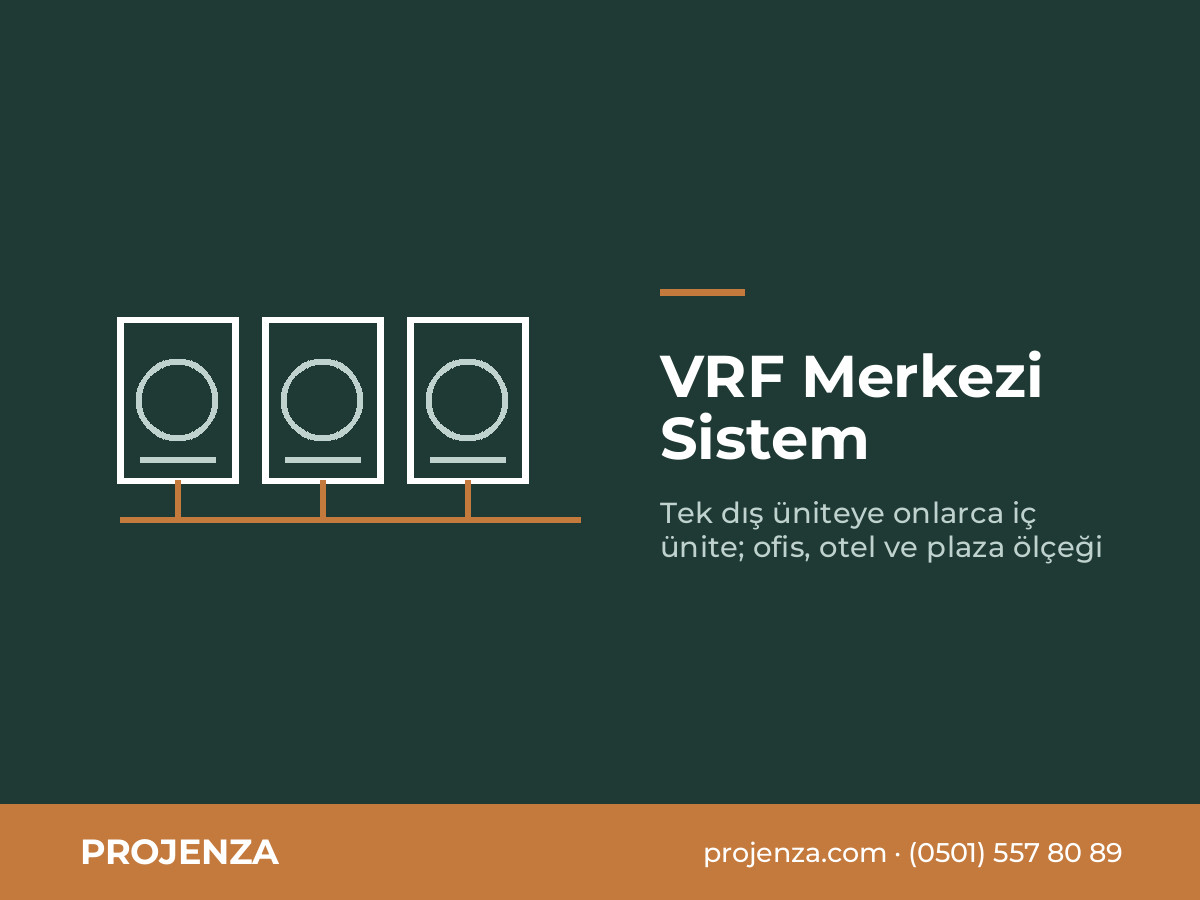
VRF (Variable Refrigerant Flow) is a central system in which dozens of indoor units connect to a single outdoor unit. The critical difference is this: the outdoor unit does not switch on and off at a fixed speed, it sends only as much refrigerant as the indoor units are asking for at that moment. While most of a floor stands empty the system spends energy only on the occupied spaces; being able to scale its capacity to demand is what puts VRF ahead in buildings with many spaces.
Each space picks its own temperature independently. On heat recovery models one room can be cooled while another is heated at the same moment — a single system answers the different demands of a sunlit south façade and a shaded north façade on the same day. Better still, the heat drawn out of the cooled space is carried to the space asking for heating instead of being dumped outside; this is the condition in which the system works at its most efficient, and it is common in the shoulder seasons.
The system also leaves a smaller mark on the building: a few units on the roof replace dozens on the walls, and maintenance gathers at one point. In return, VRF is not an appliance but an installation — the refrigerant pipework is permanent infrastructure that will stay inside the building for years. That is why getting the route, the insulation and the refrigerant charge right at design stage matters more than which brand of unit you buy.
Key Features
- Part-load efficiency: a system almost never runs at full load, and VRF holds its efficiency at part load
- Management from one point: every indoor unit is monitored centrally, working-hours scenarios are defined, empty floors are turned down automatically
- Simultaneous heating and cooling on heat recovery models; heat taken from a cooled space is carried to a space that wants heating
- Commissioning and expansion floor by floor — a scalable installation
- A clean façade: a few units on the roof instead of dozens on the walls
- Cassette, ducted, wall-mounted and floor-standing indoor units can be mixed on the same system
How to Choose
- The load calculation is essential: VRF is not a forgiving system. If the load calculation, pipe runs and indoor unit selection are not right from the start, comfort complaints get blamed on the system.
- Plan the pipework before the units: route, insulation and height difference are decisions you cannot revisit later; the indoor unit model can change, the pipework cannot.
- Plan maintenance from the outset: if the filters of dozens of indoor units and the outdoor coil are not cleaned to a schedule, efficiency quietly melts away.
- Choose the indoor unit type per space: cassette, ducted and wall-mounted can be mixed on the same system.
- Combine it with energy management: add a central control layer and VRF stops being merely air conditioning and becomes the building’s energy management tool.
Get a free site survey and a quote for your project: (0501) 557 80 89 · bilgi@projenza.com


Reviews
There are no reviews yet.