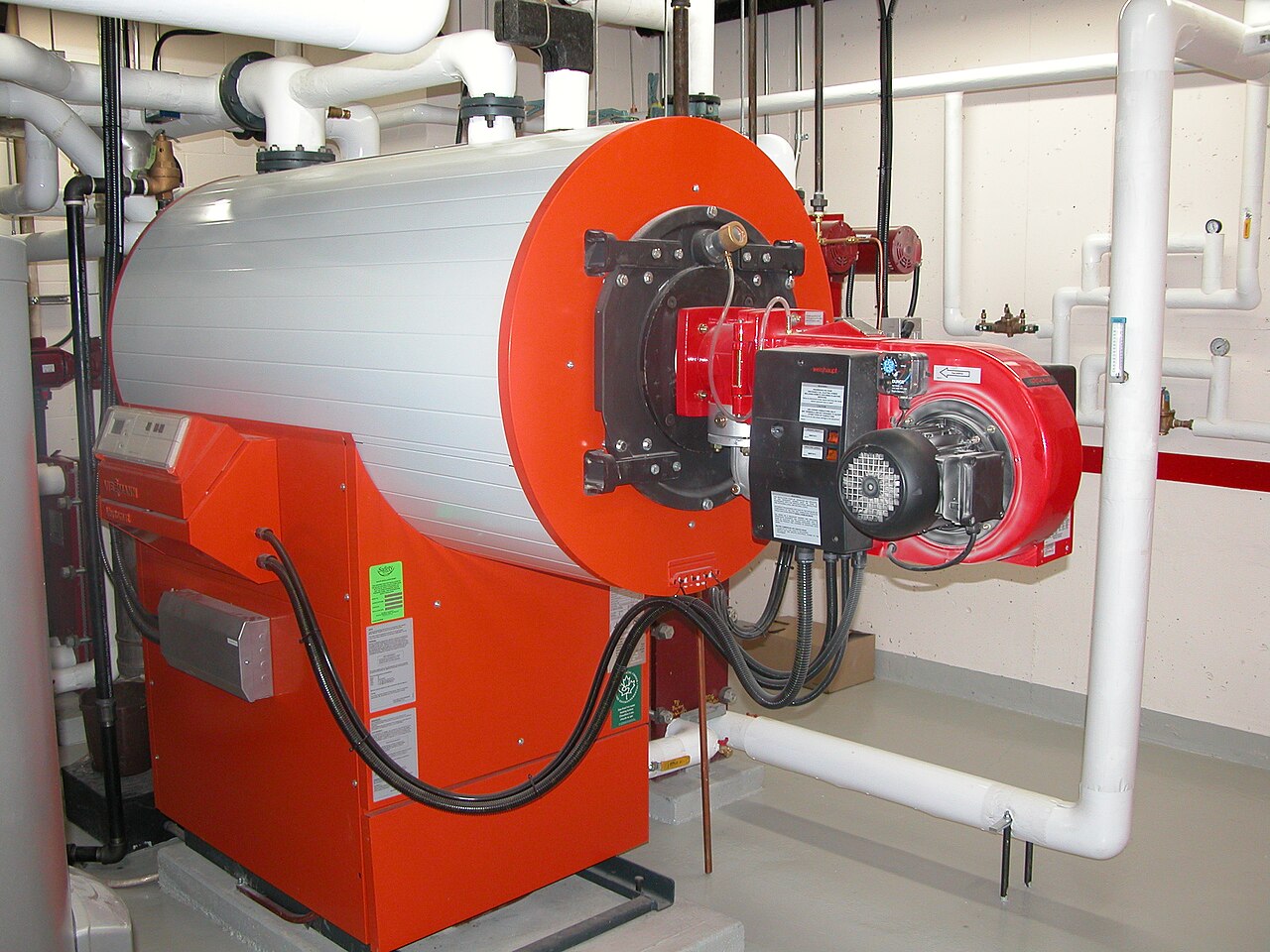
Description
Best fit: apartment blocks and residential estates on central heating, hotels and halls of residence with continuous hot water demand, production sites needing process heat, refurbishment projects where an existing plant room is being renewed, and corporate buildings whose heat demand swings widely through the day.
A boiler is the heat source of a building, passing what it produces to the heating circuit and, where required, to the production of domestic hot water. A boiler on its own is not a system, though: unless circulation, expansion, safety equipment, the flue and the controls all work together, even the best boiler will not deliver what was expected of it. A plant room is therefore designed and commissioned as a whole rather than chosen as a single appliance.
A heating installation is sized for the coldest design day, yet most of the season is far milder than that day. The boiler therefore spends almost its entire life running at part load. A single large boiler in that condition cycles on and off continuously, and every stop and start costs both fuel and wear. A boiler with a wide modulating range, or an arrangement in which several boilers stage up and down, removes that loss by keeping capacity close to what the building actually needs.
The promise of a condensing boiler is to recover the latent heat given up when water vapour in the flue gas condenses. That only happens when the return water is cold enough; when the return comes back warm the appliance does not condense and behaves like a conventional boiler. Buying a condensing boiler is therefore not sufficient on its own, because the installation has to be able to produce a low return temperature. Generously sized emitters, balanced circuits and a control that lowers flow temperature as outside temperature rises are what create that regime.
The plant room itself is a safety matter. An uninterrupted supply of combustion air, a flue whose draught and material suit the type of appliance, correctly selected expansion equipment and accessible safety devices are all beyond negotiation. Where the boiler condenses, disposal of the acidic condensate has to be planned separately. Service clearance left around the plant looks like a luxury at first glance, and yet it governs the speed and the quality of every maintenance visit for years afterwards.
The last factor deciding the life of the system is the water itself. Hardness in the system water deposits on heat transfer surfaces, reducing output and causing local overheating, while oxygen starts corrosion and in time produces sludge. That sludge wears pumps and valves and leaves the bottom of emitters cold. Treating the fill water, fitting a system filter and a magnetic separator, and flushing the system at commissioning are tasks separate from the boiler that nevertheless decide how long the boiler lasts.
Key Features
- Central heating and, where needed, domestic hot water met from a single source
- Staged operation and wide modulation keeping capacity close to the real load
- Condensing and conventional options weighed against the temperature regime of the installation
- Weather compensating control that lowers flow temperature as outside temperature rises
- Expansion, safety equipment and flue compatibility established as one whole
- A plant room solution covering condensate disposal and combustion air
- Heat transfer surfaces protected by water treatment, a system filter and flushing
How to Choose
- Fuel type and its infrastructure: the existing connection, any storage needed and the suitability of the plant room.
- Building heat loss and pattern of use: how widely the load swings across the day and the season.
- How far the return temperature can be lowered: whether condensing operation is genuinely achievable.
- Plant room volume, combustion air, flue draught and a flue material suited to the appliance.
- Domestic hot water demand: instantaneous or stored production, and how much of it is simultaneous.
- Water quality, treatment plan and service access: maintenance clearance, spares and response time.
Get a free site survey and a quote for your project: (0501) 557 80 89 · bilgi@projenza.com
Brands We Work With




Reviews
There are no reviews yet.