
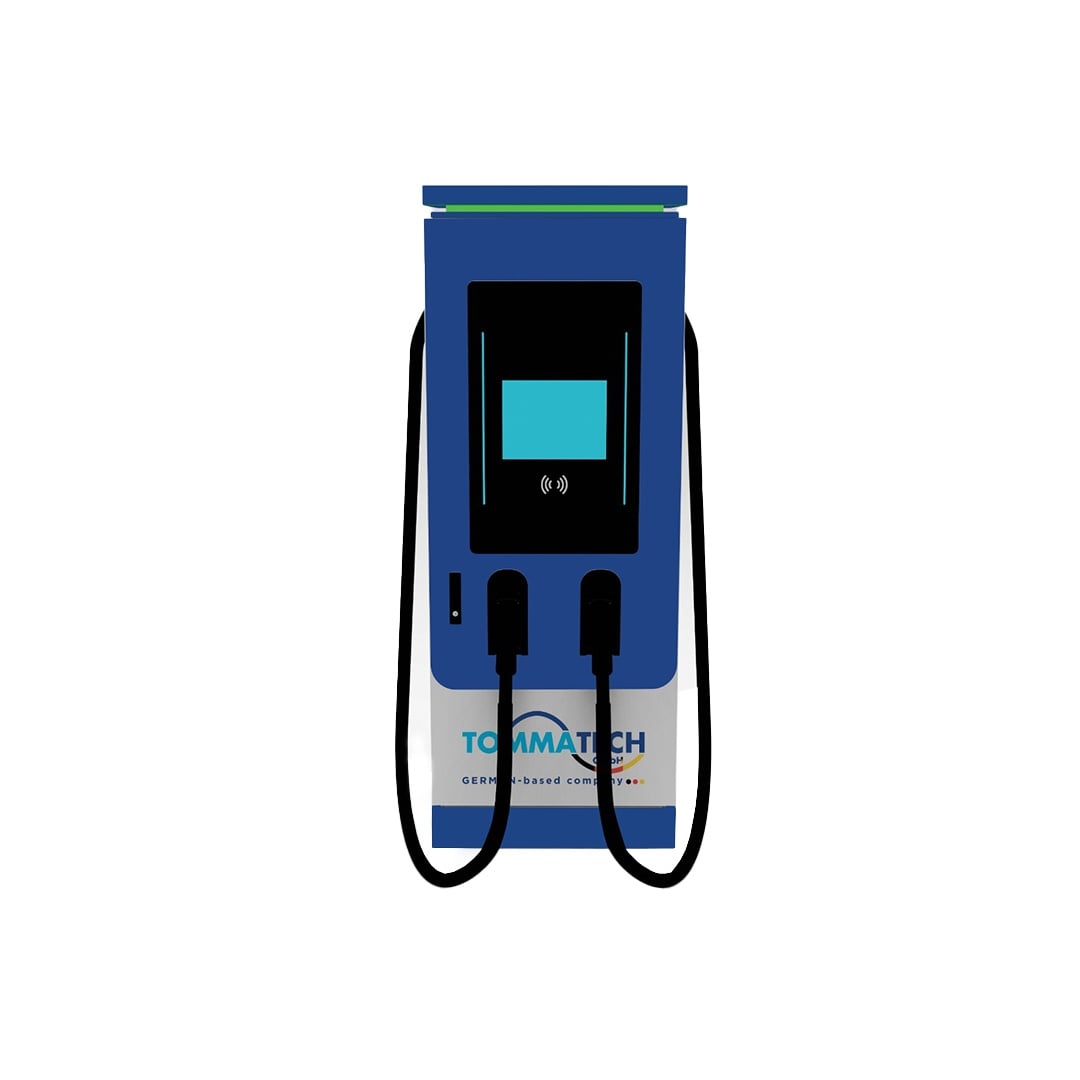
Description
Best fit: workplace and office car parks, hotels and other accommodation, retail and visitor parking, depots where fleet and service vehicles stand overnight, and residential garages — in short, anywhere it is known where a vehicle stands and for how long.
A charging point is better thought of not as a device but as something attached to the time a vehicle spends parked. The real design input is dwell time rather than power: where a car stands overnight or for a full working day, an alternating current station is comfortably enough, while a point where the driver stops only briefly calls for a direct current supply. Most badly specified installations come from passing over that question without ever asking it.
An alternating current station feeds the converter built into the vehicle, which means the real ceiling is usually set by the car rather than by the station. In direct current fast charging that on-board converter is bypassed, the battery is fed directly, and the conversion moves inside the station instead. The way a battery tapers its own current as it approaches full is part of the same picture: the value on a station’s label never describes charging time on its own.
Most of the decision is made at the electrical panel rather than in the car park. The capacity already available at the building’s supply point, the spare room in the distribution board, the length of the cable route and the voltage drop along it, protection able to detect direct current leakage, and the earthing arrangement — these set both the cost and the limit of the installation. Siting the station close to the board is the cheapest piece of engineering in most projects.
Upgrading the building’s supply is not always necessary. Dynamic load management measures what the building as a whole is drawing and trims charging power the moment the building peaks, so more points can be installed under the same supply. Phase balance follows the same logic: if every single-phase charging point sits on the same leg, the building is loaded unevenly. Where there is solar generation on site, shifting charging into the hours of high output is usually worth more than exporting to the grid.
What remains is operation. Identifying who charged and how much by card or app, a calibrated meter wherever energy is resold, and an open communication protocol so that equipment from different makers can work together — all of these are hard to add later and easy to specify at the start. Outdoors, protection against water and dust, bollards against impact, an arrangement that keeps the cable off the ground and a locking connector are the normal expectation. Leaving spare conduit for future points while the ground is still open is the cheapest item in the job, and the one most often regretted.
Key Features
- Specified around dwell time: alternating current for long stays, direct current fast charging for short stops
- Designed against supply capacity, spare room in the board, cable route and voltage drop
- Protection that also detects direct current leakage, a suitable disconnecting device and an earthing arrangement
- Dynamic load management that trims charging power at the building peak and keeps the phases balanced
- User identification by card or app, with calibrated metering wherever energy is resold
- An open communication protocol for remote monitoring, fault reporting and interoperability
- Outdoor installation: protection against water and dust, impact bollards, cable management and a locking connector
How to Choose
- Dwell time and usage pattern: overnight, a full working day, or a short stop.
- Electrical infrastructure: capacity available at the supply point, spare room in the board, and the length of the feeder.
- Number of points and growth plan: how much is installed today and how far the site should reach later.
- Need for load management: whether charging coincides with the building peak, and whether there is solar generation.
- Operating model: charging offered free or billed, and the identification and metering that follow from it.
- Location and physical conditions: indoors or outdoors, vehicle manoeuvring space, cable length, exposure to impact and weather.
Get a free site survey and a quote for your project: (0501) 557 80 89 · bilgi@projenza.com
Reviews
There are no reviews yet.