
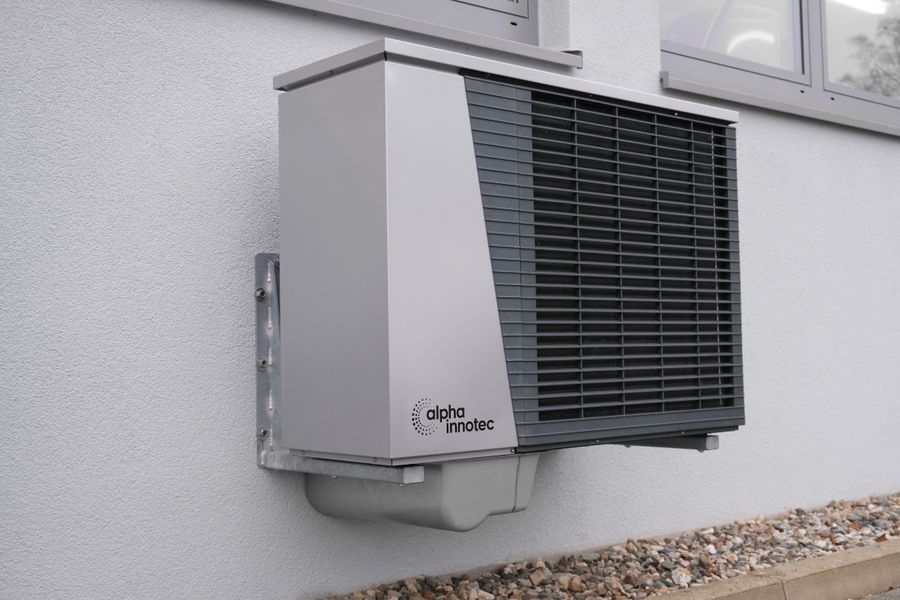
Description
Where it is the right choice: in new villas and detached houses alongside underfloor heating; in areas with no gas infrastructure it is effectively the only sensible candidate.
A heat pump runs on electricity but it is not an electric heater; it moves heat in from the outside air, from water or from the ground. Being able to deliver several times as much heat as the electricity it consumes puts its running cost level with natural gas and, in most scenarios, ahead of it. On top of that it cools in summer.
Efficiency depends directly on the operating temperature: the lower the water temperature, the higher the efficiency. That is why it gives its best results with low-temperature systems such as underfloor heating and fan coils; if it is to be connected to a radiator installation, the suitability of that installation has to be assessed first. Efficiency is measured as a single-point coefficient of performance (COP) and as a seasonal coefficient (SCOP) to the relevant European standards.
On the heating side two curves work against each other: as it gets colder outside, the building needs more heat, while the appliance is able to deliver less. Choosing a unit is therefore not a matter of a single capacity value but of placing the point where those two curves cross — the balance point — where it belongs. In cold, humid weather frost also builds up on the outdoor coil, and the unit periodically reverses its cycle to melt it off. During this defrost interval heating pauses briefly and energy is spent. Together with the way the outside temperature varies across the season, that is one of the main reasons seasonal efficiency sits below single-point efficiency.
A heat pump is not a standalone appliance but a system: the size of the heat-emitting surface, the water volume in the circuit, the insulation of the building and the control strategy decide the outcome as much as the machine itself does. A well-chosen unit connected to a mismatched circuit cannot make use of its advantage. On the control side the setting that makes the most difference is weather compensation: instead of holding the flow temperature fixed, it raises it only as far as the weather of that day requires. Running a heat pump like a boiler, at a fixed high setpoint, means giving away from the outset the very place its efficiency comes from.
Key Features
- Air source: the most practical and most widespread solution to install; ideal for homes, villas and flats
- Water source: very high efficiency on projects with a water source; for commercial facilities and large capacities
- Ground source: the most stable solution where ground and borehole conditions allow, with the lowest long-term running cost
- Both heating and cooling from one appliance, with a domestic hot water option
- High efficiency at low water temperature with underfloor heating and fan coils
- Variable-speed (inverter) compressor: instead of cycling on and off it follows the load, running continuously at low speed — a gain in both efficiency and quiet operation
How to Choose
- What is your existing system? Underfloor heating is ideal. With radiators the required water temperature is higher, so efficiency falls; we assess this at the survey.
- Insulation: in a building with high heat loss no heat source runs economically. We size capacity from the building’s real heat load.
- Outdoor unit position: an air source unit needs clear airflow and a position where noise will not affect neighbours.
- Winter performance: an air source unit loses capacity as the outside temperature falls. The balance point and any need for supplementary heat are found by reading the appliance’s catalogue curve together with the building’s heat load line.
- Electrical infrastructure: the distribution board and supply are checked for adequacy against the chosen capacity.
- Water volume in the circuit: if the volume is small, or zone valves keep shutting the circuit down, the unit falls into short cycles, and both efficiency and compressor life suffer. We determine at the survey whether a buffer tank or a hydraulic separator is needed.
Get a free site survey and a quote for your project: (0501) 557 80 89 · bilgi@projenza.com
Reviews
There are no reviews yet.