
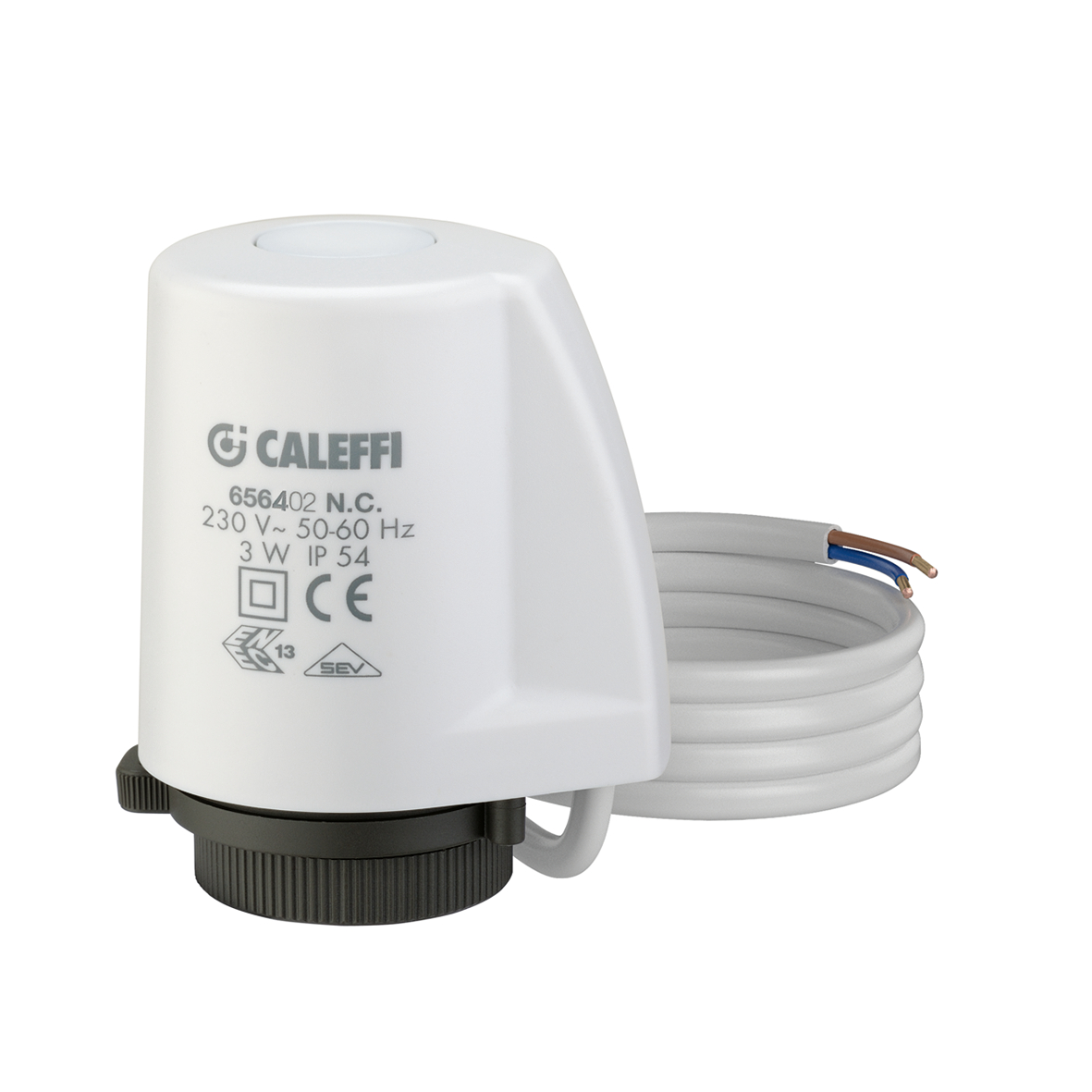
Description
On an underfloor heating manifold each loop serves a separate room. Whether a room can hold its own temperature depends on that loop being opened and closed at the manifold, and the part doing the work is the actuator.
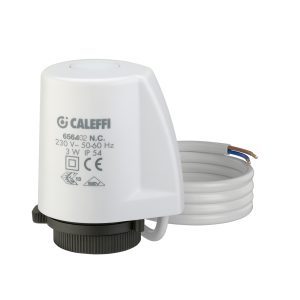
An actuator is a small device that turns the electrical signal from a room thermostat into mechanical movement on the stem of a manifold valve. The type most widely used in underfloor heating is thermoelectric: inside the housing sit a heating element and an expanding filling; when the element is energised the filling expands and drives a piston forward against the valve stem. There is no rotating motor, no gearbox and no rubbing bearing, so it produces no audible noise in operation and carries no obvious source of mechanical wear.
The slow movement of a thermoelectric actuator is often mistaken for a shortcoming, when in fact it is exactly the behaviour underfloor heating wants. Opening a loop gradually over some minutes prevents an abrupt disturbance of the flow distribution across the manifold and avoids water hammer at the moment of closure. Underfloor heating already has a thermal inertia measured in hours; there is nothing for the system to gain from a valve that changes position in milliseconds, and something to lose.
Normally closed and normally open behaviour is a safety decision rather than a comfort preference. This choice determines the state the system falls back to when power is lost or a cable is broken. In a normally closed arrangement the loops shut on failure and the space stops being heated; in a normally open arrangement the loops stay open and the space can overheat. Which is correct depends on how the building is used, on the risk of freezing, and on how the heat source behaves when left to itself.
Connection equipment is the quiet but most critical link in this chain. The adapter between the manifold stem and the actuator reconciles the differing stem geometries of different manufacturers. A wrong or loose adapter cannot press the stem fully home; the loop looks closed but never closes completely. This is among the most common complaints in the field: the thermostat has switched off yet the room keeps warming, because a leakage flow continues to circulate through the loop. The fault is not in the thermostat but in a millimetre of mismatch.
Actuators are wired together with the thermostats and the heat source through a wiring centre. The centre collects which rooms are calling, energises the corresponding actuators, and passes a demand signal to the circulating pump and the heat source once at least one loop has opened. Without this chain the pump runs for nothing, or conversely the source stays off while loops are open. If every loop can close at the same time, the hydraulic side needs an answer too: a fixed speed pump pushing against a closed circuit raises pressure and starts to make noise, and either a variable speed pump or a bypass arrangement has to absorb that condition.
Maintenance is usually neglected, because a failed actuator makes no noise — the room is simply cold, or simply warm. A stem left in one position for a long period can stick, an adapter can work loose, a terminal can lose contact. Energising every loop one by one before the heating season begins and confirming by eye that the stem moves will eliminate most of the comfort complaints that are otherwise very hard to diagnose during the season.
Key Features
- Silent thermoelectric operation — with no rotating motor and no gearbox, nothing audible is carried into the living space
- Gradual opening and closing — flow distribution across the manifold is not disturbed abruptly and no water hammer occurs at closure
- Quick fitting with a clip-on or threaded adapter — when the manifold brand changes the adapter changes, while the actuator can stay the same
- Normally closed and normally open options — the state the system falls back to on power loss is decided as a project matter
- A first-position feature that eases installation — loops can be held open before the system is energised, making filling and air venting straightforward
- Built to work alongside room thermostats, wiring centres and building automation — the control layer can also be extended later
How to Choose
- Manifold stem compatibility: the first and most frequently skipped item on the list. Matching the actuator to the correct adapter matters more than the merits of the product itself; an ill-fitting connection will not close the loop fully.
- Normally closed or normally open: the decision concerns safety before comfort. In spaces exposed to freezing, and in systems running from a single heat source, this choice deserves separate consideration.
- Thermostat and wiring centre compatibility: decide from the outset whether the control layer will be wired or wireless, whether the number of actuators fits the capacity of the centre, and whether rooms may be added later.
- Cable length and route: the distance between the manifold cabinet and the wiring centre determines whether a pre-wired actuator will reach. Joints made in the cabinet are the weakest link inside it.
- The hydraulic answer: where all loops can close at once, variable speed or a bypass arrangement must be planned on the pump side. Actuator selection is not independent of pump selection.
- Layout inside the cabinet: actuators demand a certain height above the manifold; if the cabinet is not sized for it the door will not shut, or no hand room is left for maintenance.
- Commissioning and labelling: which actuator serves which room must be marked permanently on the manifold. An unlabelled cabinet means trying every loop in turn at the first fault.
Get a free site survey and a quote for your project: (0501) 557 80 89 · bilgi@projenza.com
Reviews
There are no reviews yet.